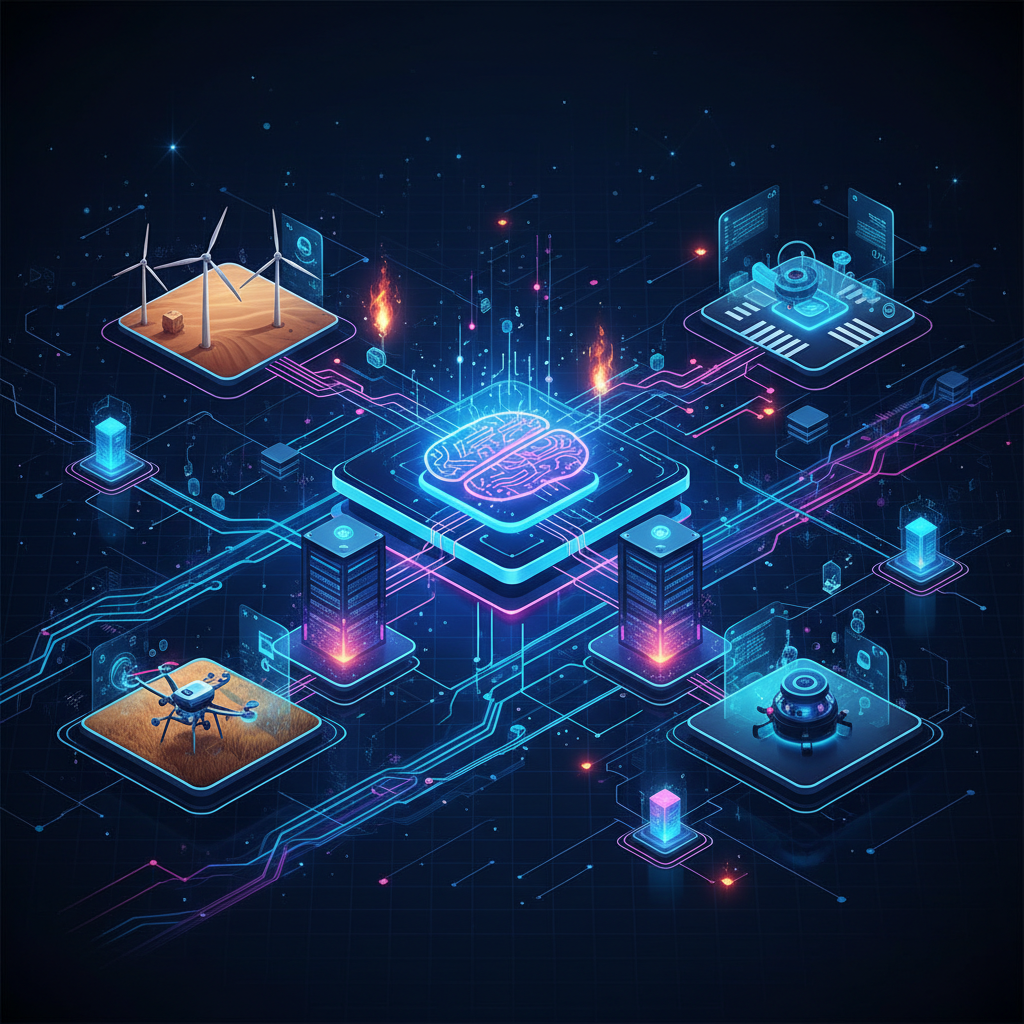
# Edge Computing and AI: The Power of Processing Data at the Source
In the era of digital transformation, data is often referred to as the new oil, with billions of sensors, devices, and users generating it every second. However, much of this data can lose its value or lead to critical delays before being transmitted to central cloud systems. This is precisely where the synergy of **Edge Computing and Artificial Intelligence (AI)** opens up a whole new realm of operational efficiency and innovation by processing data at its source, as it is generated.
Why Edge AI? The Need for Speed and Efficiency
Traditional cloud-based AI models inherently suffer from latency due to the cycle of sending data to the cloud, processing it, and sending results back. In critical applications like autonomous vehicles, industrial automation, or smart healthcare systems, this delay can lead to unacceptable risks. Edge AI minimizes this latency, enabling decisions to be made instantly and locally. By eliminating the need for continuous data transmission over the network, it reduces bandwidth costs and optimizes network traffic. Furthermore, processing sensitive data locally offers significant privacy and security advantages, complying with regulations like GDPR. For instance, the computation required for an instant decision by a factory robot is performed on an Edge AI chip (e.g., NVIDIA Jetson or Google Coral) embedded within the robot itself, rather than in the cloud.
Architectural Approaches and Implementation Challenges
Edge AI architectures combine the scalability of the cloud with the agility of edge devices. However, this integration comes with its own set of challenges. The limited processing power, memory, and power consumption of edge devices require AI models to be specifically optimized for these platforms. This increases the importance of techniques such as model compression (quantization, pruning) and TinyML. While model training typically occurs in the cloud, inference is performed on the edge device. Hybrid cloud-edge approaches are adopted for continuous learning and model updates. For example, an IoT device managed by a Flutter application can process an image with a local AI model and only transmit anomalies to the cloud. Security, device management, and network variability are also key implementation challenges for these architectures.
Key Use Cases and Emerging Trends
Edge AI's application areas span a wide range, from smart cities to Industry 4.0, retail to healthcare:
* **Smart Factories:** Real-time detection of anomalies on the production line, predictive maintenance, and quality control. * **Autonomous Vehicles:** Instantaneous processing of environmental data (camera, lidar) to make safe driving decisions. * **Smart Cities:** Traffic management, security camera analytics, and environmental monitoring systems. * **Healthcare Services:** Remote patient monitoring, local analysis of data from wearable devices, and emergency detection.
Among current trends, research into running smaller and more efficient large language models (LLMs) on edge devices, and high-performance Edge AI applications developed with Rust, are noteworthy. These developments are making it possible to integrate more complex AI capabilities directly into devices.
Example Scenario: Real-time Image Recognition on an Edge Device
Consider a scenario where a security camera needs to detect specific objects (e.g., suspicious packages). Instead of sending the entire video stream to the cloud, the camera analyzes images instantly using its onboard Edge AI processor. Only when a suspicious situation is detected is the relevant image segment and alert message sent to the cloud.
import cv2
import numpy as np
from tensorflow.lite.python.interpreter import Interpreter
def run_edge_inference(image_path, model_path): # Load the TFLite model interpreter = Interpreter(model_path=model_path) interpreter.allocate_tensors()
# Get input and output tensors details input_details = interpreter.get_input_details() output_details = interpreter.get_output_details()
# Load and prepare the image img = cv2.imread(image_path) img = cv2.resize(img, (input_details[0]['shape'][1], input_details[0]['shape'][2])) input_data = np.expand_dims(img, axis=0)
# Set the input tensor interpreter.set_tensor(input_details[0]['index'], input_data)
# Run inference interpreter.invoke()
# Get results (e.g., classification scores) output_data = interpreter.get_tensor(output_details[0]['index']) # Find the class with the highest score predicted_class = np.argmax(output_data[0]) confidence = np.max(output_data[0])
print(f"Object detected: Class {predicted_class}, Confidence: {confidence:.2f}") if predicted_class == 1 and confidence > 0.8: # Example: '1' might represent a suspicious package print("\n!!! Suspicious package detected. Sending alert to cloud... !!!") # Code to send alert to cloud or trigger local alarm could go here else: print("No abnormal situation. Local processing complete.")
# Usage example # run_edge_inference('sample_image.jpg', 'optimized_model.tflite') print("Edge device AI inference simulation started...") # In a real application, a model like 'optimized_model.tflite' and image from a camera would be used.
This simple Python code demonstrates how a TensorFlow Lite optimized model can be used on an Edge device. The image is processed locally, and only critical information (alerts) might be sent to the cloud for further analysis.
Shape Your Future With Us
Are you ready to shape the future of your business with Edge Computing and Artificial Intelligence? Contact us to develop tailored strategies and bring your projects to life with our innovative solutions. Let our expert team unlock your full potential and help you gain a competitive advantage by processing data at its source. With our strong R&D background and expertise in cutting-edge technologies (Rust, React, Flutter, LLM integrations), we are here to empower you.