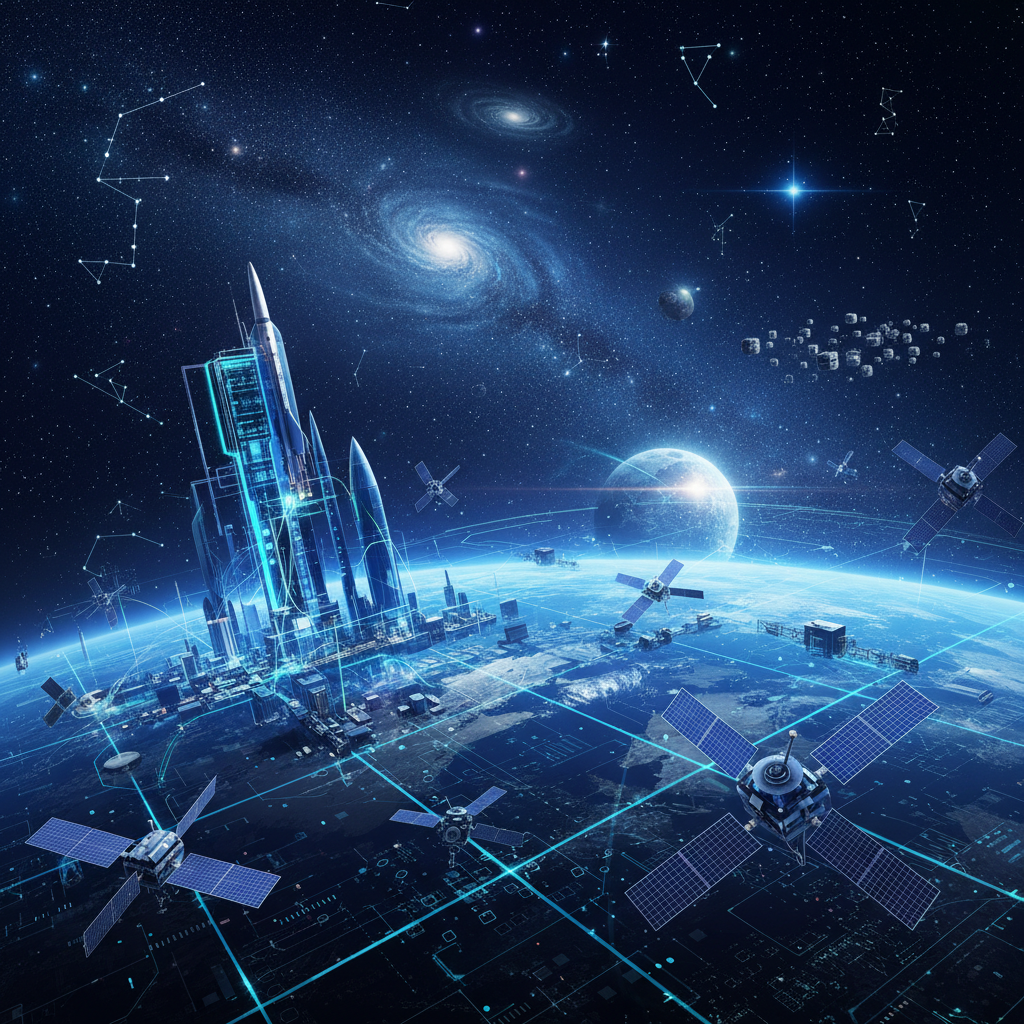
# The Internet of the Space Age: Satellite Technologies and Our Future
Space technologies promise much more than just the dream of interstellar travel. Satellite internet, in particular, has become a revolutionary force, transforming global communication, bringing high-speed connectivity to inaccessible regions, and opening doors to new industries. In this article, we will take a look at the present and bright future of satellite technologies, from Low Earth Orbit (LEO) satellites to AI integration.
The Rise of Low Earth Orbit (LEO) Satellites and Mega-Constellations
Unlike traditional geostationary satellites, LEO satellites orbit much closer to Earth (200-2000 km). This proximity offers significantly lower latency (ping) and higher bandwidth. Projects like Starlink, OneWeb, and Amazon Kuiper aim to establish mega-constellations of thousands of satellites, providing global coverage. This is a game-changer, especially for rural and remote areas where fiber optic infrastructure is non-existent. The potential to bridge the global digital divide is one of the most striking benefits of these technologies.
Transformative Applications of Satellite Internet
Satellite internet is not just for home users; it offers a wide range of industrial and social benefits:
* **Rural and Developing Regions:** Bridging the digital divide, increasing access to education, healthcare, and economic opportunities. * **Disaster Relief:** Providing a critical communication bridge in disaster zones where terrestrial infrastructure has collapsed. * **Maritime and Aviation:** Offering continuous, high-speed internet access on ships and airplanes. * **Internet of Things (IoT):** Ensuring reliable connectivity for remote sensor networks, agriculture, and environmental monitoring applications. * **Autonomous Vehicles:** Supporting future autonomous systems by providing redundancy and broad coverage for vehicle-to-vehicle (V2V) and vehicle-to-infrastructure (V2I) communication.
Future Satellite Technologies and AI Integration
Satellite technologies are becoming even smarter and more efficient by integrating artificial intelligence (AI), machine learning (ML), and big data analytics:
* **Network Optimization:** AI optimizes traffic in satellite networks in real-time, minimizing latency and maximizing bandwidth. * **Autonomous Satellite Systems:** Satellites are becoming capable of autonomously adjusting their orbits, avoiding collisions, and resolving malfunctions. * **Space-Based Data Processing:** Satellites process vast amounts of collected data (images, sensor data) in space before sending them to ground stations, reducing bandwidth load and enabling instant analysis. * **Quantum Communication:** In the future, Quantum Key Distribution (QKD) systems could provide ultra-secure communication from space, elevating cybersecurity to an unprecedented level.
Satellite Internet-Powered Smart Agriculture Monitoring System
**Scenario:** In a vast agricultural area in eastern Turkey, where terrestrial internet infrastructure is weak, you want to set up an IoT sensor network to monitor soil moisture, temperature, and nutrient levels. These sensors should collect data every 30 minutes, send it to a central cloud platform, and provide farmers with intelligent irrigation and fertilization recommendations.
**Solution:** In this scenario, a satellite internet service like Starlink ensures the seamless and reliable transmission of sensor data to the central system. Each sensor station can be equipped with a low-power microcontroller (e.g., ESP32) and a small satellite modem (or a technology like LoRaWAN connected to a satellite gateway).
**Concept Code (Data Transmission):**
import time
import random
# This is a conceptual representation for sending data to a satellite modem API.
# Real-world applications would use satellite modem SDKs or protocols like MQTT over Satellite.
def get_sensor_data(): """Generates simulated sensor data.""" soil_moisture = random.uniform(20.0, 60.0) temperature = random.uniform(15.0, 30.0) nutrient_level = random.uniform(1.0, 5.0) return { "timestamp": int(time.time()), "device_id": "farm_sensor_001", "soil_moisture": round(soil_moisture, 2), "temperature": round(temperature, 2), "nutrient_level": round(nutrient_level, 2) }
def send_data_via_satellite(data): """Simulates sending data over a satellite network.""" print(f"[{time.ctime()}] Sending data to satellite network: {data}") # In reality, this would be a satellite modem API call or an MQTT publish operation. # E.g.: satellite_modem.send(json.dumps(data)) if random.random() < 0.95: # 95% success rate print("Data sent successfully.") return True else: print("Data transmission failed. Retrying...") return False
if __name__ == "__main__":
    print("Smart Agriculture Sensor Network Started (Satellite Powered)")
    while True:
        sensor_data = get_sensor_data()
        success = send_data_via_satellite(sensor_data)
        if success:
            print("Waiting 30 minutes for the next data transmission...")
        time.sleep(1800) # Wait 30 minutes (1800 seconds)
Do you want to leverage the limitless potential of space technologies and propel your business into the future? With our expertise across a wide range of services, from space-based communication and IoT solutions to AI integration and custom software development, we are here to provide tailor-made solutions for you. Contact us for more information and collaboration!